By Dr Leonora Alberts Vilakazi
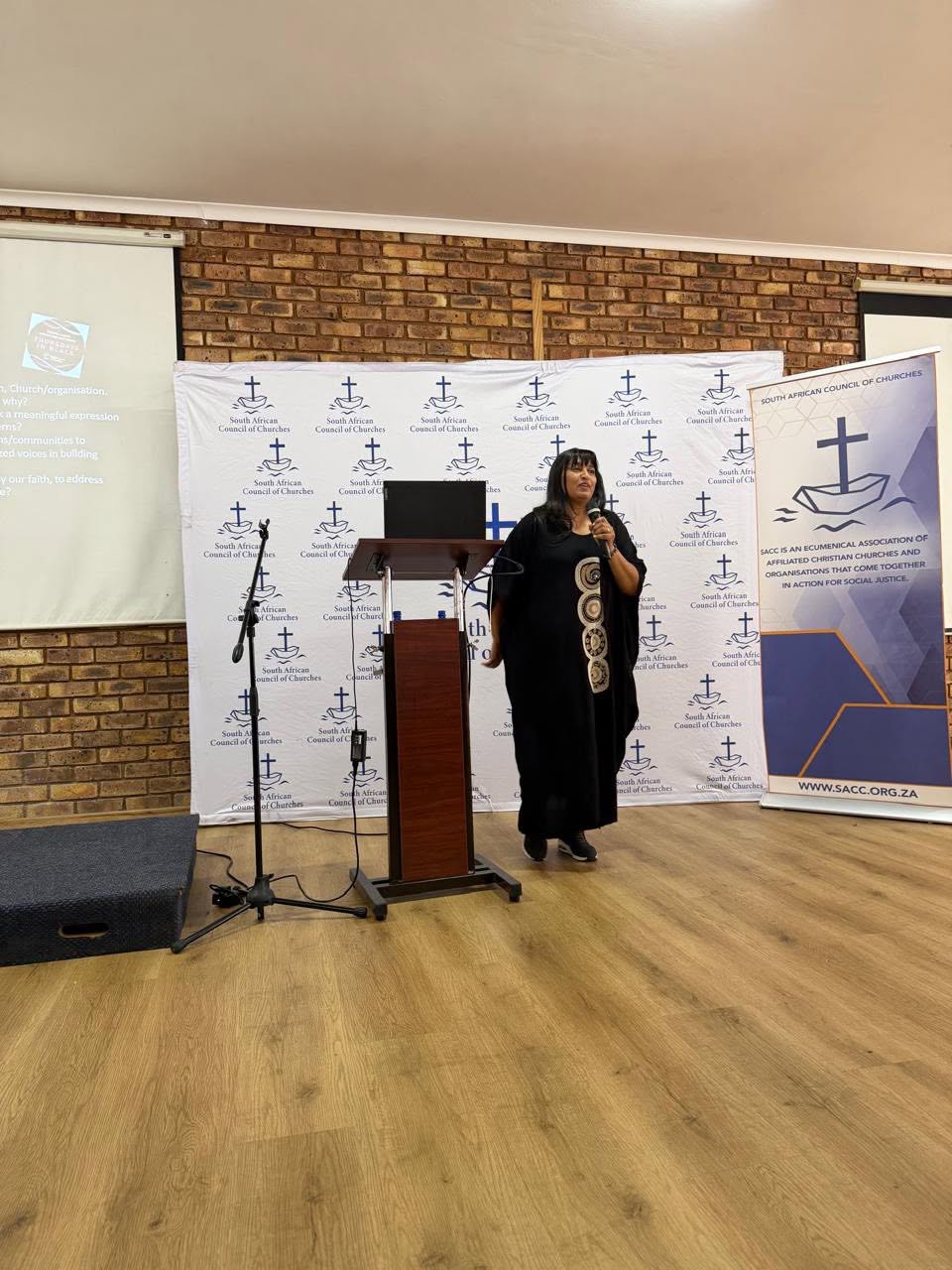
In the Faith Action Collective’s first Lunchtime Conversation on 10 September 2025, we looked at the alignment of our Interfaith GBV Prevention and Mitigation Strategy with South Africa’s National Strategic Plan on GBVF.
The 40 participants were all actively engaged in the conversation, with one commenting. “This was actually a fruitful conversation and I appreciate the time shared.”
Vision: NSP on GBVF
”A South Africa Free from Gender-Based Violence directed at women, children and LGBTQIA+”
Focus: This vision is broad and all-encompassing. It outlines a comprehensive national goal to eliminate gender-based violence (GBV) without specifying a particular sector. It explicitly names the groups most affected: women, children, and the LGBTQIA+ community.
Vision: Interfaith GBV Prevention and Mitigation Strategy
”An inclusive and Harmonious Society in South Africa that is Free of Gender-Based Violence”
Focus: This vision is more specific to a particular sector – the interfaith community. It emphasises the creation of a “harmonious society” through the active participation of faith communities.
“The interfaith approach considers prevention as transforming society as a whole, linked to a strong values base. The Interfaith Strategy also emphasises the need for transforming ourselves and our institutions as the foundation for transforming society and ending GBV. It looks inwards as well as outwards,” shared Daniela Gennrich, Coordinator of WWSOSA and Co-coordinator of the Faith Action Collective.
How they incorporate one another
While they are separate statements, they are not contradictory; rather, they are complementary and work together to achieve a common goal. Here’s how they incorporate one another.
Shared Ultimate Goal: Both visions share the same fundamental objective: a South Africa that is free of gender-based violence. The NSP sets the overall, national-level goal, while the Interfaith Strategy contributes to that goal from its specific sector.
Sector-Specific Contribution: The NSP is the overarching framework. It recognises that to achieve a GBV-free South Africa, contributions from all sectors of society are needed. The Interfaith Strategy provides a blueprint for how the religious and faith-based sector can and should contribute to the NSP’s vision.
Building Blocks: The Interfaith vision can be seen as a “building block” or a key component of the larger National Strategic Plan. By focusing on creating an “inclusive and harmonious society,” the Interfaith Strategy addresses the root causes of GBV from a moral, spiritual, and community-based perspective, which is crucial for achieving the NSP’s broader vision of safety for all citizens.
Inclusivity: The National Strategic Plan is “for all of South Africa,” including the interfaith community. The Interfaith Strategy, in turn, is about how faith communities can be “inclusive” and work towards the national goal, ensuring that they are part of the solution and not contributing to the problem.
The NSP recognises that no single sector can end GBVF alone. The Interfaith Strategy offers a blueprint for how faith communities can contribute meaningfully – through prevention, survivor support, and ethical leadership,
While the NSP focuses on structural reform, the Interfaith Strategy addresses the spiritual and relational dimensions of violence. It challenges patriarchal interpretations, promotes inclusive theology, and centres survivor dignity
The Interfaith vision is not a parallel effort – it’s a foundational building block within the NSP’s architecture. It ensures that faith communities are not only included but equipped to lead with integrity and compassion.
Call to Collaborative Action: These are not separate mandates, but as interdependent pathways toward a GBV-free South Africa.
What does this mean for our faith ministries? Our task is to ensure that faith-based contributions are documented, amplified, and integrated into national policy and practice – so that healing, justice, and dignity are not just ideals, but lived realities. Furthermore, to take this into our daily work as faith institutions.
Let us continue to build together – with courage, clarity, and collective accountability