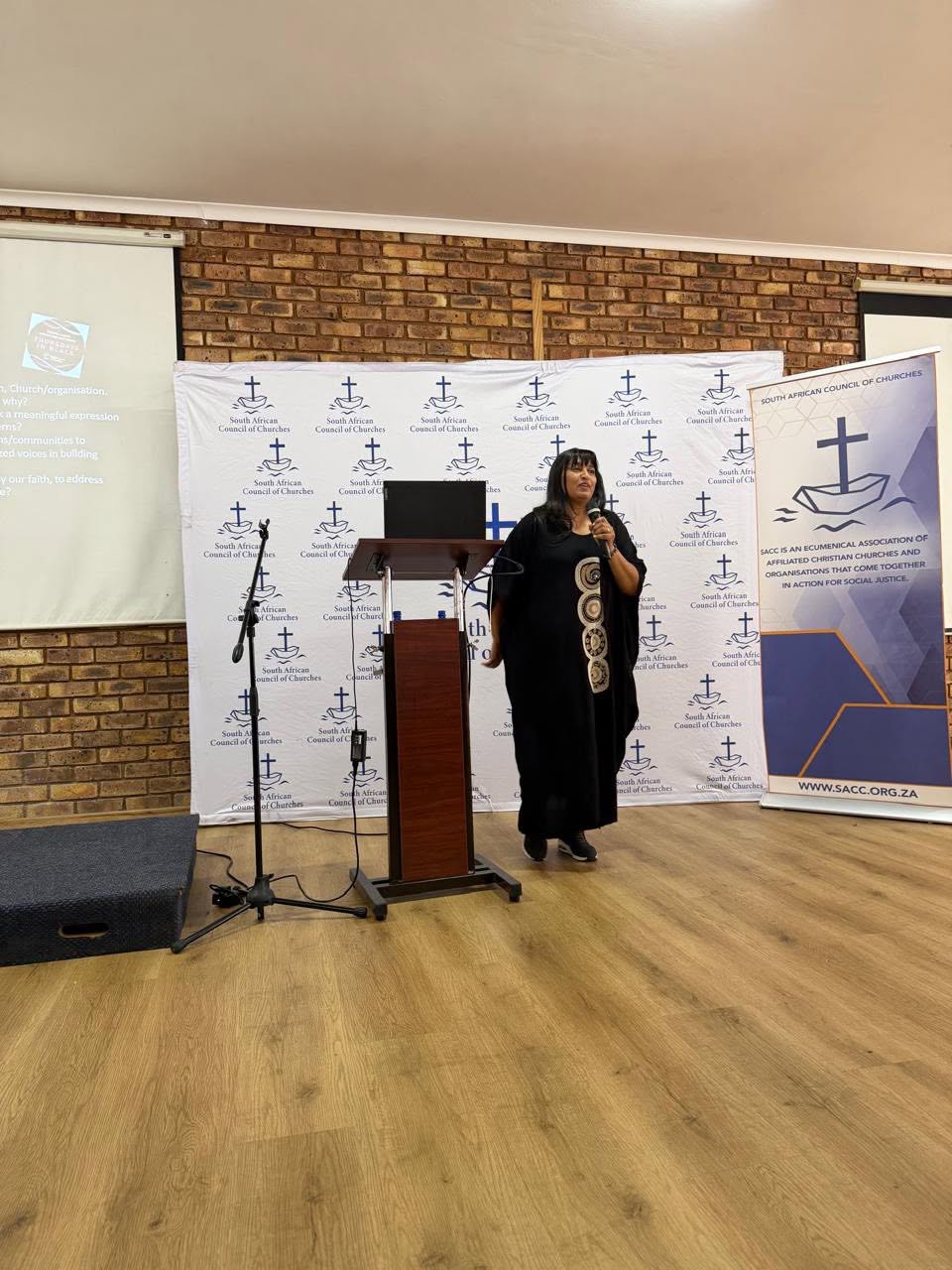
At a recent WWSOSA Lunchtime Conversation on Spiritual Abuse, Daniela Gennrich — Coordinator of We Will Speak Out South Africa and a Lay Canon in the Anglican Church — chose to do something that takes real courage: she shared her own story.
She was careful, in offering it, to name what it was and was not. “This story is a kind of a minor story in many ways,” she said, acknowledging that what she experienced did not involve the total violation of body that many others carry, and that she did not wish, in sharing it, to add to anyone else’s pain. She spoke, too, with awareness of others in the room who had lived through extreme forms of spiritual abuse and violence within their own places of worship. Her aim in sharing was simple: to draw out the lessons from her own journey, not to centre her experience above anyone else’s.
Unequally Yoked
Her story began when she was just eighteen — newly arrived at Rhodes University, having left behind a boyfriend she loved deeply. They had been together for two years and had already begun, young as they were, to speak of marriage.
Soon after arriving at university, Daniela had a dramatic born-again experience, despite having been raised in the German Lutheran Church. She wanted, more than anything, to be the best Christian she could be — to prove her devotion fully. It is this desire, she reflected, that represents one of the real vulnerabilities faith leaders and communities need to be alert to.
The Pentecostal/evangelical church she had newly joined preached often about purity, and about the importance of marrying within the same faith. Her boyfriend was Catholic. When he came to visit and she brought him to a service, she was called in shortly afterwards by the church’s main pastor and his wife. She was told she could not be “unequally yoked” to someone of a faith the this church did not recognise as valid, because he was not ‘born again’. They warned her that she was betraying God. And then came a claim that has stayed with her since: that because God exists outside of time, she was, in effect, already committing adultery in advance, with someone else’s future husband. (A ludicrous misuse of Scripture.)
Caught inside this logic, and already deeply vulnerable in her desperation to serve God faithfully, Daniela was told she would need to make sacrifices — she recalls being compared to Abraham and the sacrifice of his son. Facing what felt like a binary choice between betraying God or betraying the person she loved, she ended the relationship. She has realised much later that what was happening to her was classic coercive control – that stripping of self-worth, gaslighting, and loss of agency that many abused women experience as they are subject to domestic violence.
The Cost
What followed was a period of profound grief — a depression so severe that she became suicidal, describing the loss as an unbearable bereavement, as though her entire future had been taken from her. She spent days lying under her bed, needing to feel safe in a contained space, until her housemate eventually pulled her out and, out of concern, called another pastor from the same church for help.
That pastor’s response compounded the harm rather than easing it. Rather than offering support, he spent a long while berating her — calling her a spoiled brat, accusing her of disobeying the church’s spiritual leaders, and invoking the biblical figure of Jezebel to shame her further, demanding she confess her sin and her disobedience.
It was, by her own account, her anger that ultimately protected her in that moment. She asked him to leave, and she swore never to set foot back in that or any other church again.
Finding a Way Back
Healing did not come from within that same church. A friend took her instead to a Catholic spiritual director, and through contemplative prayer and a more direct experience of God’s unconditional love, she began to recover — although she could not bring herself to enter a church again for some time. Eventually, she found her way to the Anglican Church, where she felt there was real space to be who she was, and became involved in a Christian social justice organisation, where she also met a new partner and built a healthier relationship.
But healing is rarely linear. Some years later, she began to experience physical illness — something she now understands as the embodiment of confusion and pain that had never been fully resolved.
Closing the Circle
About 15 years after the events at Rhodes University, Daniela moved to a town where, by coincidence, the same pastor who had once told her she was “a jezebel” was now lecturing at the local university. She made a deliberate decision to confront him — and was, she admits, terrified even after all that time.
She knocked on his door. He answered. She asked him directly whether he had any idea what he had done to her life.
What happened next was not what she had expected. The same church leader had, in the years between, come to his own understanding of what had happened — though neither of them, even then, used the term “spiritual abuse” to name it. He offered a sincere apology and took full responsibility for the damage he had caused. He told her that he himself had been hurt by the very same church as he had begun to question, and that he had since left. His own wife had been so embroiled in that church and its twisted teachings, that he not only left the church but also his wife, taking his sons with him. He had been a broken man, but in a similar way as Daniela, he had found healing in putting into words (as an academic theologian) what he had experienced and developing his own deep relationship with the God of love and justice. They prayed together. In being able to speak her truth plainly and being seen and heard, Daniela found a depth of healing she says is rare. It was made possible, too, by the years she had spent since, as a gender activist within the church. This gave her the language and framing to finally make sense of what had happened to her.
Why Share Now?
Daniela’s reason for telling this story publicly is direct: so many people, she says, have experienced similar emotional, mental and spiritual abuse, which has often led to them tolerated much worse harm than she had. By speaking up, she hopes that others will be able to begin to put words to their experiences too.
As a Christian, she has found direction in the example of Jesus himself. He spoke out directly against spiritual and financial abuse perpetrated by the religious authorities of his time through their temple economy and other abuses. He always stood on the side of the marginalised and the vulnerable, and fearlessly challenged religious authorities who insisted that their way was the only way to please the god of their own making, and crucified the one man who had the courage to unmask their sham.
Healing often begins with simply being able to put language to what happened — language that makes it possible to understand, to process, and ultimately to move toward a renewed and healed relationship with a God she describes as loving unconditionally. She hopes that telling her simple story will help others to understand their own and encourage others to do the same. Building a strong movement of solidarity and healing can grow into a powerful movement for institutional and societal change.
*This account is shared with Daniela Gennrich’s own words and consent, as part of WWSOSA’s ongoing work to give language and visibility to spiritual abuse within faith communities.
This is a sensitive topic. If anything in this story resonates with your own experience, please know that support is available — reach out to We Will Speak Out South Africa or the Faith Action Collective to End GBV to find help, hope, and a community that believes you. Email: communication@wwsosa.org.za WhatsApp 084 581 0622