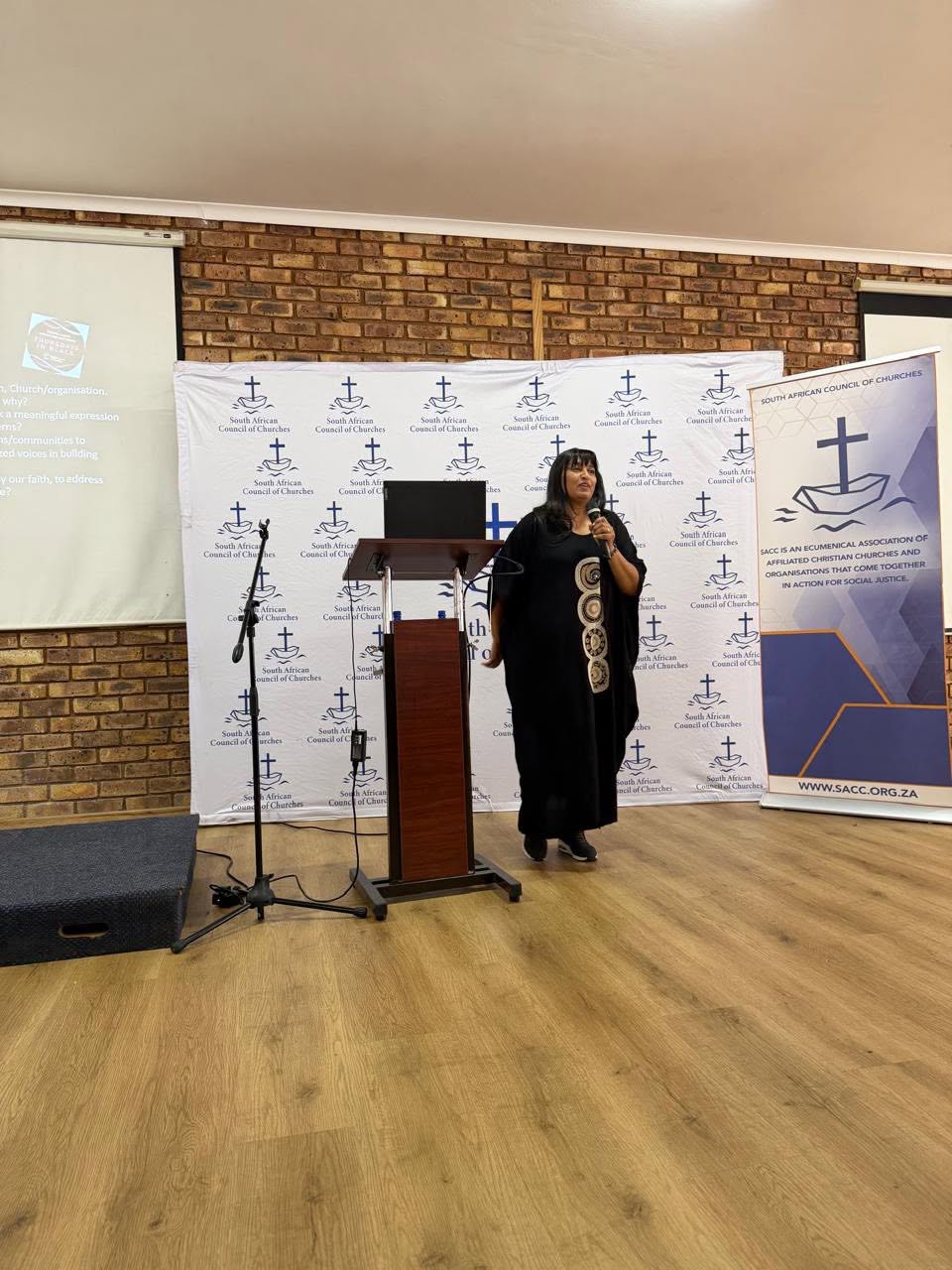
Last week, We Will Speak Out South Africa (WWSOSA) hosted its Monthly Forum in honour of Women’s Month, welcoming feminist theologian Dr Nontando Hadebe to reflect on a question that sits at the heart of our work: what does it really mean for women to lead in faith spaces?
Dr Hadebe’s presentation, “Leadership and Women in Faith Spaces,” was both a theological reflection and a personal testimony — tracing how scripture has been read in radically different ways when it comes to women’s authority, and how her own leadership journey has been shaped by principles she has had to fight to live out.
Same text, contradictory readings
Dr Hadebe opened by naming something many in faith communities feel but rarely say aloud: the Bible is a shared sacred text, yet its interpretations are multiple and often contradictory — not only on core practices like baptism, the Eucharist and ministry, but specifically on the question of women’s leadership.
She outlined three broad positions that continue to shape churches across the continent:
– Fixed, God-ordained gender roles, where men are positioned as powerful leaders and women as followers, expected to be submissive.
– Unequal equality, the belief that all human beings are equal in worth, but that biological difference nonetheless determines male leadership and female subordination.
– Full equality, where leadership is understood as a matter of gift and calling — not gender.
Naming these three positions side by side made one thing clear: the barriers many women face in faith leadership are not accidents of culture, but the product of specific theological choices — choices that can be, and are being, challenged.
A journey lived across the continent
Dr Hadebe then turned to her own story. She currently leads within the Side by Side Interfaith Movement for Gender Justice, an initiative hosted by WWSOSA that brings together people of faith, faith leaders and faith-based organisations across three regions: West Africa (Nigeria, Burkina Faso, Ghana, Sierra Leone and Mali), East and Central Africa (Kenya, Uganda and Burundi), and Southern Africa (Zimbabwe, South Africa and Malawi).
Side by Side’s mission is simple to state and demanding to live: partnering across borders and denominations to challenge the barriers to gender justice within faith spaces. In her role, Dr Hadebe coordinates chapters across all three regions, collaborates with partner organisations doing parallel work, and cultivates ongoing learning, assessment and collaboration between them — work made possible, she noted, through the support of WWSOSA, the Side by Side Global Secretariat (GSG), and the chapters and faith communities themselves.
Five principles for leading well
The heart of Dr Hadebe’s address was a set of five principles that she said have come to define her own leadership:
1. Relationships — because, as she put it plainly, “leaders lead people.” She grounded this in the Christian principle of the inherent dignity and equality of all people, arguing that this conviction should shape every interaction, every response, every conversation — compassion, forgiveness, kindness, truth-telling, and a refusal to reduce people to labels.
2. Responsibility — taking ownership of the organisation without excuse, and being willing to bear the weight of failure as much as success. Growth, she said, requires risk-taking and sometimes standing alone. As the saying goes: you make the path by walking it.
3. Collaboration and teamwork — drawing on the wisdom of others, remaining a lifelong learner, and staying open to insight from outside one’s own discipline and from different stakeholders.
4. Character, self-mastery and discipline — leading from within, and paying close attention to one’s own attitudes and responses, particularly when no one is watching. This includes aligning with one’s values, pursuing excellence, doing the deeper spiritual work, and practising self-care — health, spiritual disciplines like silence, simplicity, surrender and solitude, and investing time in life-affirming activities.
5. Lifelong learning — deliberately expanding into other disciplines and fields. Dr Hadebe pointed to research showing that just 20 minutes of reading a day is often what separates a thought leader from the rest.
Setting the world ablaze
Dr Hadebe closed with the words of St Catherine of Siena: “Be who you are, and you will set the world ablaze” — often rendered as “Be who God meant you to be, and you will set the world on fire.” For her, this is a call to authentic holiness: we make our greatest impact not by imitating someone else’s version of leadership, but by fully embracing the gifts we have each been given.
For WWSOSA, this Forum was a reminder of why spaces like this matter. Ending gender-based violence in faith communities isn’t only about accountability and safeguarding — as vital as that work is. It’s also about actively building up the kind of leadership that makes abuse of power less likely to take root in the first place: leadership rooted in dignity, humility, self-examination and service.
We are grateful to Dr Hadebe for sharing her journey so openly with our Monthly Forum, and we look forward to continuing this conversation as Women’s Month continues.